


How Many Implants Are Needed for a Toothless Jaw?
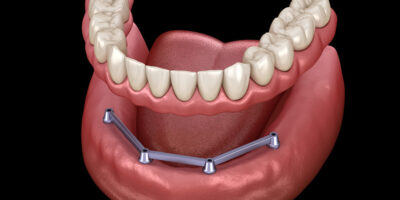
Losing teeth—especially when it leads to complete edentulism—can cause significant problems in appearance, speech, nutrition, and even self-confidence. Fortunately, with advances in modern dentistry, dental implants have become the most reliable solution for restoring smiles and replacing missing teeth. One of the most common questions patients ask is:
?How many implants are required to restore a fully edentulous jaw
Let’s review the number of implants needed under different clinical conditions.
Dental Implants as Artificial Roots
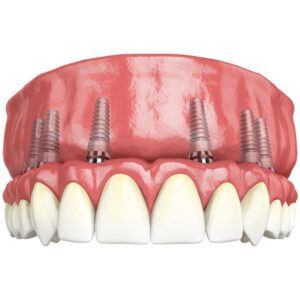
A dental implant functions like an artificial tooth root placed inside the jawbone, providing a solid foundation for a crown or prosthesis.
- For one missing tooth, one implant is sufficient
- For two missing teeth, typically two implants are placed
- For three missing teeth, depending on bone quality and available implant dimensions, two or three implants may be required
In general, weaker bone conditions call for a higher number of implants.
Implant-Supported Overdentures
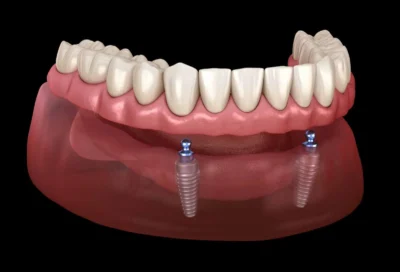
One popular method for restoring a toothless jaw is using implant-supported overdentures. In this treatment, the removable denture is secured by implants for better stability.
- In the lower jaw, a minimum of 2 implants is necessary, though 2 to 4 implants are commonly used for optimal stability.
- In the upper jaw, at least 4 implants are recommended due to lower bone density compared to the mandible.
Fixed Prosthesis on Implants for Edentulous Jaws
For patients who prefer permanent, natural-like teeth, a fixed implant-supported prosthesis is an excellent solution. In this method, the prosthesis is permanently attached to the implants and cannot be removed by the patient.
- For full lower jaw restoration, a minimum of 6 implants is required, though in many cases 6 to 8 implants provide better results.
- For full upper jaw restoration, due to lower bone density, at least 8 implants are typically needed to ensure strength and functionality.
- Advantages of Dental Implants
- Restores natural appearance and aesthetics
- Improves speech and pronunciation
- Provides greater comfort in eating compared to traditional dentures
- Enhances self-confidence and overall quality of life
- Preserves adjacent teeth without the need for preparation or reduction
- Prevents jawbone resorption and facial sagging
- Long-lasting solution (many implants last a lifetime with proper care)
Conclusion
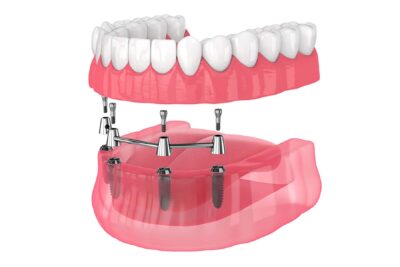
To answer the main question: For a fully edentulous jaw, depending on the type of prosthesis (removable or fixed) and bone conditions, between 2 and 8 implants are required.
Overdentures: 2–4 implants in the lower jaw, and at least 4 implants in the upper jaw
Fixed prosthesis: 6–8 implants in the lower jaw, and at least 8 implants in the upper jaw
The final decision on the number of implants depends on the implantologist’s assessment, bone quality, oral condition, and patient’s budget.
At Sayeh Gostar Mehr, we proudly supply high-quality dental equipment and materials, supporting dental professionals and clinics to provide patients with the best treatment experience.