

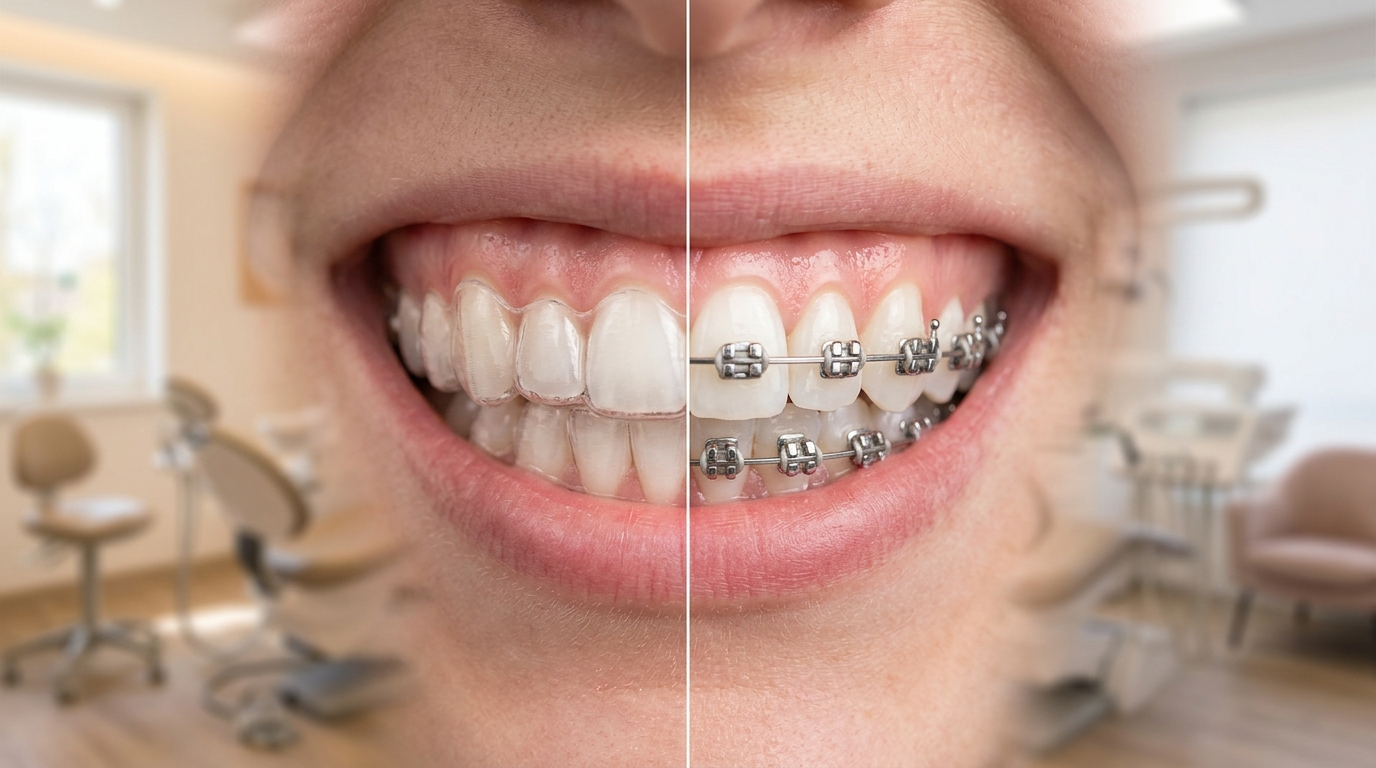

تیم تخصصی سایه گستر سلامت • Oct 20, 2026
Metal Braces vs. Clear Aligners: A Biomechanical, Clinical, and Practical Comparison
Selecting the optimal orthodontic appliance to correct dentofacial malocclusions is one of the most critical decisions facing clinicians and patients. For decades, traditional fixed metal appliances (braces) have served as the undisputed gold standard for smile correction and occlusal rehabilitation. However, rapid advancements in digital dentistry, high-precision intraoral optical scanners, and thermoformed shape-memory polymers have catapulted clear aligners into mainstream clinical practice.
Are clear aligners merely a cosmetic alternative, or do they possess the mechanical predictability to challenge fixed appliances in complex orthodontic cases? In this clinical review by Sayeh Gostar Salamat, we systematically compare the biomechanical force systems, three-dimensional torque control, periodontal preservation, patient lifestyle impacts, and economic considerations of both modalities in light of recent American Association of Orthodontists (AAO) literature.
1. Biomechanical Foundations: Continuous vs. Intermittent Staged Forces
The fundamental distinction between metal braces and clear aligners resides in their biomechanical force delivery systems to the periodontal ligament (PDL) and surrounding alveolar housing:
- Continuous Force Mechanics in Fixed Appliances: Metal braces utilize stainless steel or titanium brackets bonded to the dental enamel coupled with superelastic Nickel-Titanium (NiTi) or beta-titanium archwires. This appliance maintains 24/7 continuous, low-to-moderate force vectors, stimulating sustained cellular osteoclastic and osteoblastic bone remodeling.
- Intermittent Staged Displacement in Clear Aligners: Engineered from advanced multilayer aromatic thermoplastic polyurethanes (such as SmartTrack material), clear aligners are programmed with discrete linear increments of 0.20 to 0.25 mm per tray. When seated over the dentition, the elastic deformation of the plastic delivers an initial force peak that gradually dissipates over days. Removing the aligners during mastication affords the PDL periodic physiological recovery intervals.
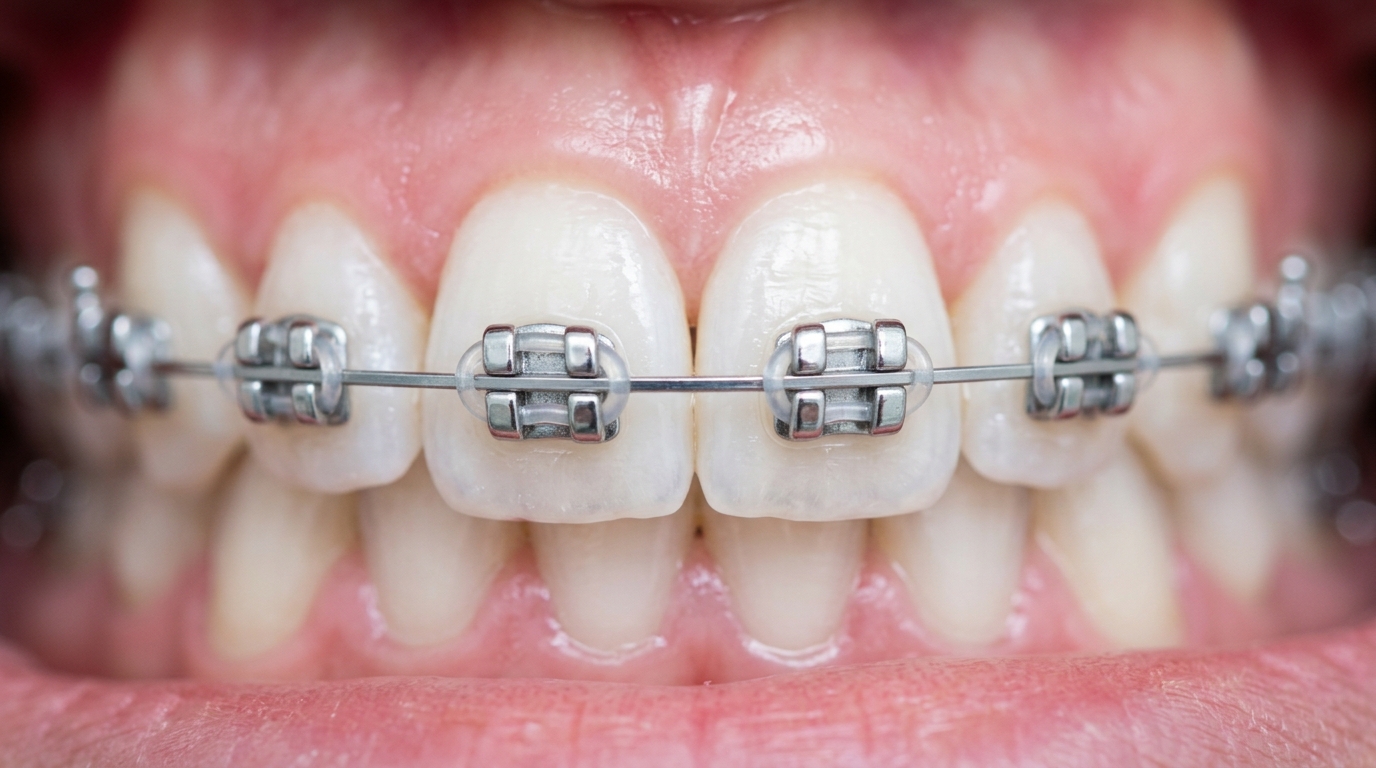 Close-up Macro Clinical View of Traditional Stainless Steel Brackets and Archwire
2. 3D Root Control, Rotations, and Bodily Movement
True orthodontic success involves controlling not merely visible coronal tipping, but the three-dimensional root axis (torque) within the cancellous and cortical alveolar plates:
- Superiority of Fixed Braces in Complex Multi-Planar Movements: Because rectangular archwires engage fully into rectangular bracket slots, clinicians can achieve exceptional torque control, bodily translation across extraction spaces, and vertical root extrusions with high mathematical predictability.
- Aligner Enhancements via Engineered Composite Attachments: Early aligners were predominantly limited to simple tipping. Modern systems overcome friction barriers by utilizing customized resin attachments bonded to specific tooth surfaces, generating active force couples for premolar/canine derotation and root paralleling. Nonetheless, severe Class II and Class III skeletal malocclusions or rotations exceeding 30 degrees remain significantly more predictable with fixed mechanics.
3. Comprehensive Head-to-Head Comparison Table
| Clinical / Lifestyle Parameter | Traditional Fixed Metal Braces | Clear Aligners (Invisalign & Digital Systems) |
|---|---|---|
| Aesthetic Discretion | High visibility; metal brackets and archwire | Virtually invisible; crystal-clear polymers |
| Removability | Fixed indwelling; cannot be removed by patient | Removable for eating, drinking, and hygiene |
| Patient Compliance Dependence | Zero behavioral reliance; works continuously 24/7 | Extreme; mandatory 20–22 hours daily wear |
| Scope of Malocclusion Coverage | Universal (mild, moderate, and severe skeletal discrepancies) | Mild-to-moderate crowding/spacing; select complex cases |
| Periodontal & Gingival Health | Prone to plaque retention, gingivitis, and biofilm traps | Significantly improved; unhindered brushing and flossing |
| Decalcification & Enamel Decals | Higher incidence of White Spot Lesions (WSLs) | Extremely low incidence when proper hygiene is observed |
| Dietary Restrictions | Strict avoidance of hard, sticky, or chewy foods | No dietary restrictions (aligners removed during meals) |
| Soft Tissue Trauma | Frequent buccal mucosa abrasions, aphthous ulcers | Minimal soft-tissue irritation due to scalloped edges |
| External Apical Root Resorption (EARR) | Slightly elevated statistical incidence under sustained forces | Lower percentage root volume loss due to intermittent load |
| Chairside Appointment Frequency | Every 4–6 weeks for wire tightening/elastic changes | Every 6–8 weeks for progress checks and tray dispensations |
| Emergency Incidents | Debonded brackets, poking distal wire ends | Lost or cracked aligner trays, thermal deformation |
[!NOTE] The Critical 22-Hour Threshold: When aligner wear falls below 20–22 hours daily, programmed tooth movements fail to express, culminating in tracking loss. This requires mid-course clinical refinements, additional intraoral scanning, and extended treatment duration.
4. Periodontal Integrity and White Spot Lesion (WSL) Prevention
One of the most concerning iatrogenic risks associated with fixed orthodontics is enamel demineralization leading to permanent White Spot Lesions (WSLs) around bracket margins. Due to appliance-induced plaque retentive sites, maintaining interdental hygiene requires laborious tools such as proxy brushes and floss threaders.
In stark contrast, clear aligners represent an immense leap forward in periodontal biocompatibility:
- Full accessibility for normal flossing and toothbrushing without obstruction.
- Statistically reduced Plaque Index (PI), Probing Depth (PD), and Bleeding on Probing (BOP).
- A far safer modality for adult patients with pre-existing treated periodontitis or fragile gingival biotypes.
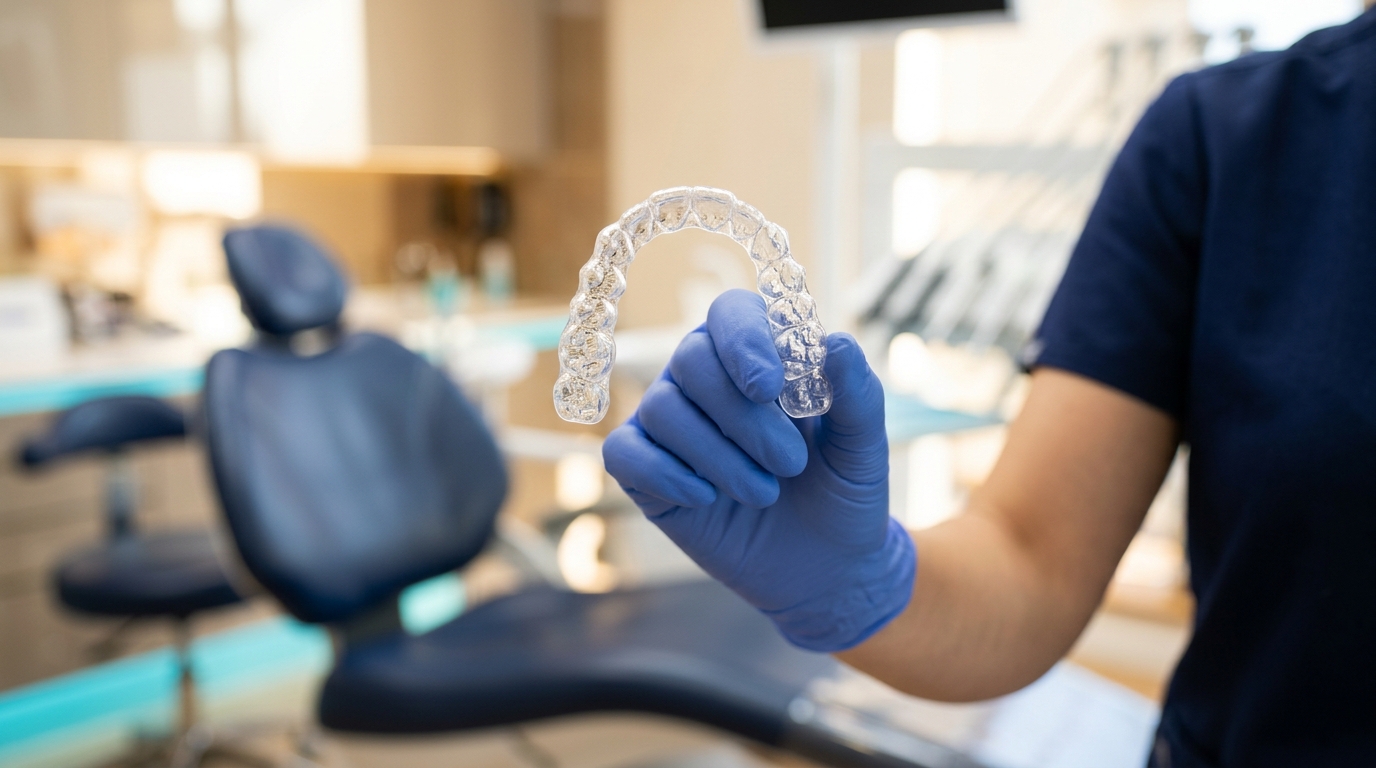 Crystal Clear Orthodontic Aligner Arch in Clinical Setting
5. The Fully Digital Aligner Workflow vs. Analog Fixed Adjustments
Clear aligner therapy is entirely anchored in modern digital dental technology:
- Intraoral 3D Scanning: Eliminates noxious silicone/alginate impressions, rendering an interactive 3D digital model in under two minutes.
- Algorithmic CAD Staging: Allows both practitioner and patient to visualize sequential tooth movements and simulated final occlusion before printing.
- High-Resolution 3D Bio-Printing & Thermoforming: Fabricates laser-trimmed, anatomically scalloped aligners optimized for patient comfort.
Fixed orthodontics, while increasingly supported by indirect digital bonding jigs, continues to rely primarily on chairside wire-bending craftsmanship.
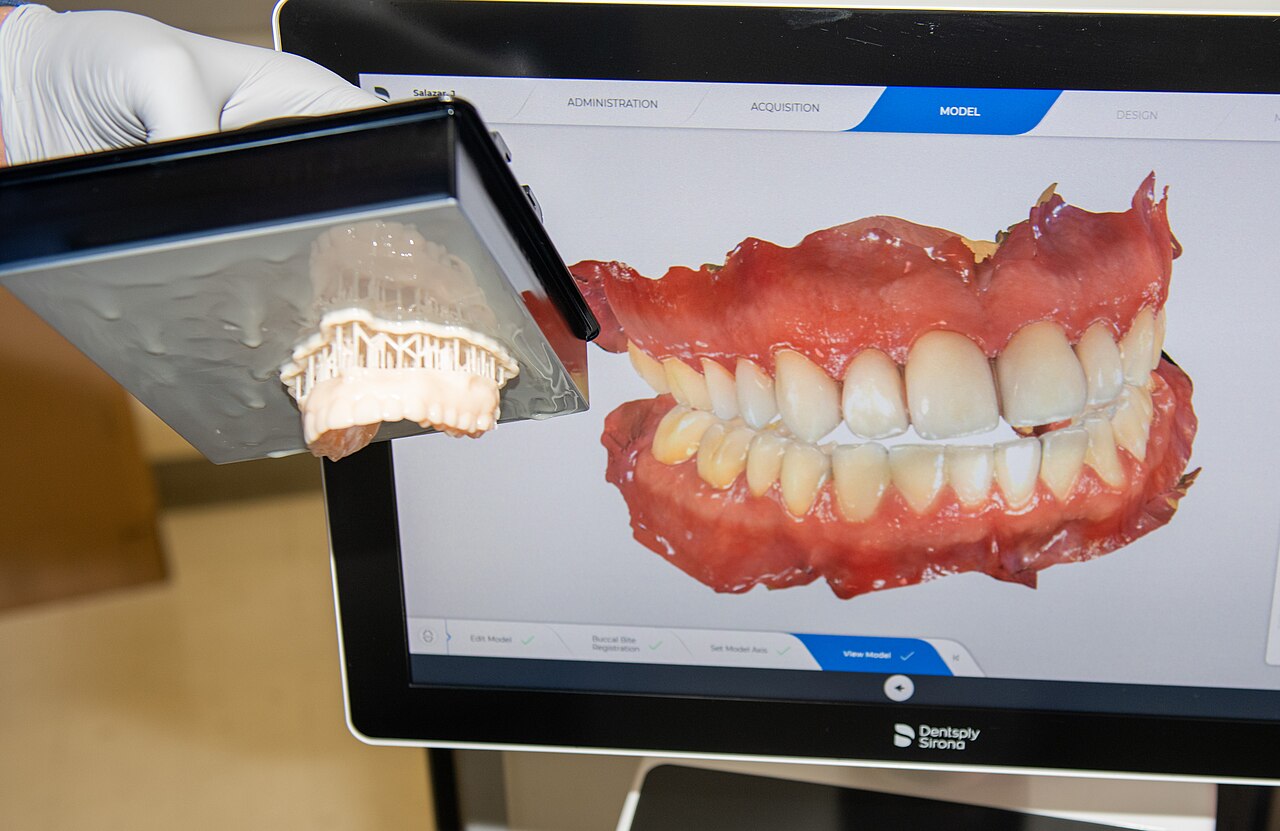 Digital CAD Staging and High-Precision 3D Dental Printing
6. Treatment Duration, Economic Value, and Patient Suitability
Does Aligner Therapy Expedite Overall Treatment Time?
In mild-to-moderate crowding or minor aesthetic corrections, clear aligners can achieve definitive alignment within 6 to 12 months—often several months faster than fixed braces due to simultaneous digital force staging. However, in severe extraction cases requiring root paralleling, overall duration between both modalities converges to roughly 18 to 24 months.
Economic Comparison
Because of the intricate digital CAD pipeline, specialized thermoforming materials, and individual 3D printing stages, clear aligner systems typically command a 20% to 50% premium over traditional metal braces.
[!TIP] Who Is the Ideal Candidate for Clear Aligners?
- Professionals, executives, and public figures prioritizing aesthetic invisibility.
- Athletes participating in contact sports where brackets pose intraoral laceration hazards.
- Highly motivated adults with mild-to-moderate malocclusion.
Who Is the Ideal Candidate for Fixed Braces?
- Pediatric and adolescent patients susceptible to non-compliance or tray misplacement.
- Severe multi-planar discrepancies, impacted canines, and significant skeletal malocclusions.
Conclusion
Neither appliance represents an absolute panacea. Traditional metal braces remain the dependable cornerstone of complex mechanical corrections, while clear aligners symbolize the convergence of aesthetic refinement, periodontal preservation, and digital dentistry.
Sayeh Gostar Salamat remains committed to empowering dental clinicians and specialized centers with verified, world-class dental equipment, intraoral scanners, and biomaterials that elevate treatment precision and patient quality of life.